
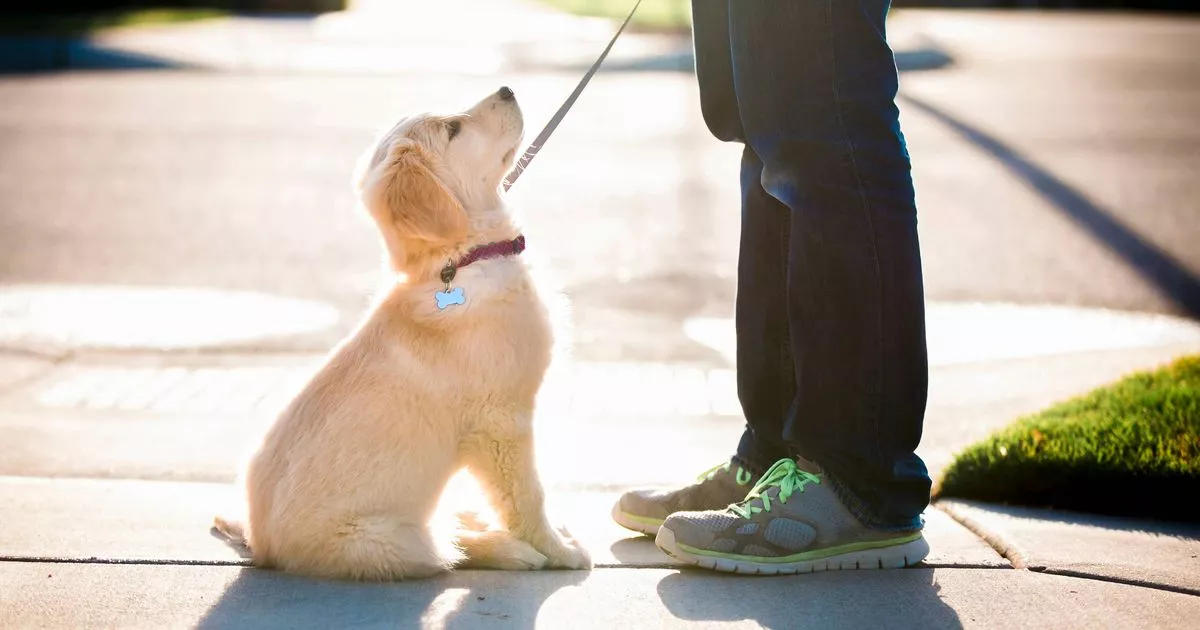
A dog trainer has urged owners to think twice before teaching puppies to ‘sit’, as they claim that an alternative command is a much easier to teach, and is also better foundation for other commands

A dog trainer is encouraging puppy owners to reconsider teaching the ‘sit’ command first, suggesting there are ‘better’ and easier commands to begin with.
For those planning to welcome a dog into their home, or who have recently brought home a puppy, early training is essential. Proper training is vital for safety, preventing behavioural issues, and strengthening the bond between humans and animals by teaching life skills, ensuring control in potentially dangerous situations (such as recall and stay), providing mental stimulation, and helping them develop into well-mannered companions who can safely experience more of the world alongside you.
However, enthusiastic new dog owners can easily rush into teaching familiar, common commands like sit. But Kim Paciotti, a dog trainer from Empowered Puppy Program, has now advised dog owners to reconsider starting with this command, as it may be too advanced for young puppies to grasp initially.
Instead, she recommended beginning with a similar command that will serve as a solid foundation for multiple other commands down the line.
“Everyone teaches sit first because that’s what they were taught,” Kim explained in the caption of her Instagram post.
She explained that many new dog owners may not appreciate that young puppies are often unaware of what their bodies are doing, as they cannot see themselves. This can create difficulties when asking them to adopt certain positions, such as sitting or lying down.
Kim said: “When you say ‘sit’, they have no idea what you’re asking for except that you seem happy when their butt hits the ground, which they can’t see happening.”
She suggested that an effective alternative to sit is teaching your dog ‘place’, which means remaining in a particular spot without moving, as this provides them with something tangible to focus on. This could involve staying on a mat or in their bed whilst awaiting your next instruction.
“And the second they understand ‘go to this spot and wait here,’ you’ve taught them the foundation of other behaviours,” the dog trainer explained.
Studies have demonstrated that dogs acquire visual cues and commands, such as going to the mat, three times more quickly than verbal instructions, like ‘sit’ and ‘lay down’.
Consequently, the dog trainer emphasised the importance of beginning with visual commands before progressing to more abstract instructions, such as sit, since ‘that’s how dogs learn’.
Kim explained that by the age of 12 weeks, puppies taught the ‘place’ command have a better grasp of impulse control. They can wait until they’re released and understand what is expected of them. Meanwhile, dogs who were only taught to ‘sit’ are still figuring out their body positions.
Her advice was met with praise in the comments section, as viewers quickly came to share their thoughts.
“So helpful!” one person wrote, while another user said: “I wish I had seen this before I started training my puppy!”.
One dog owner asked: “Is place and their crate separate spaces or the same?” To which Kim clarified that they were different places.