
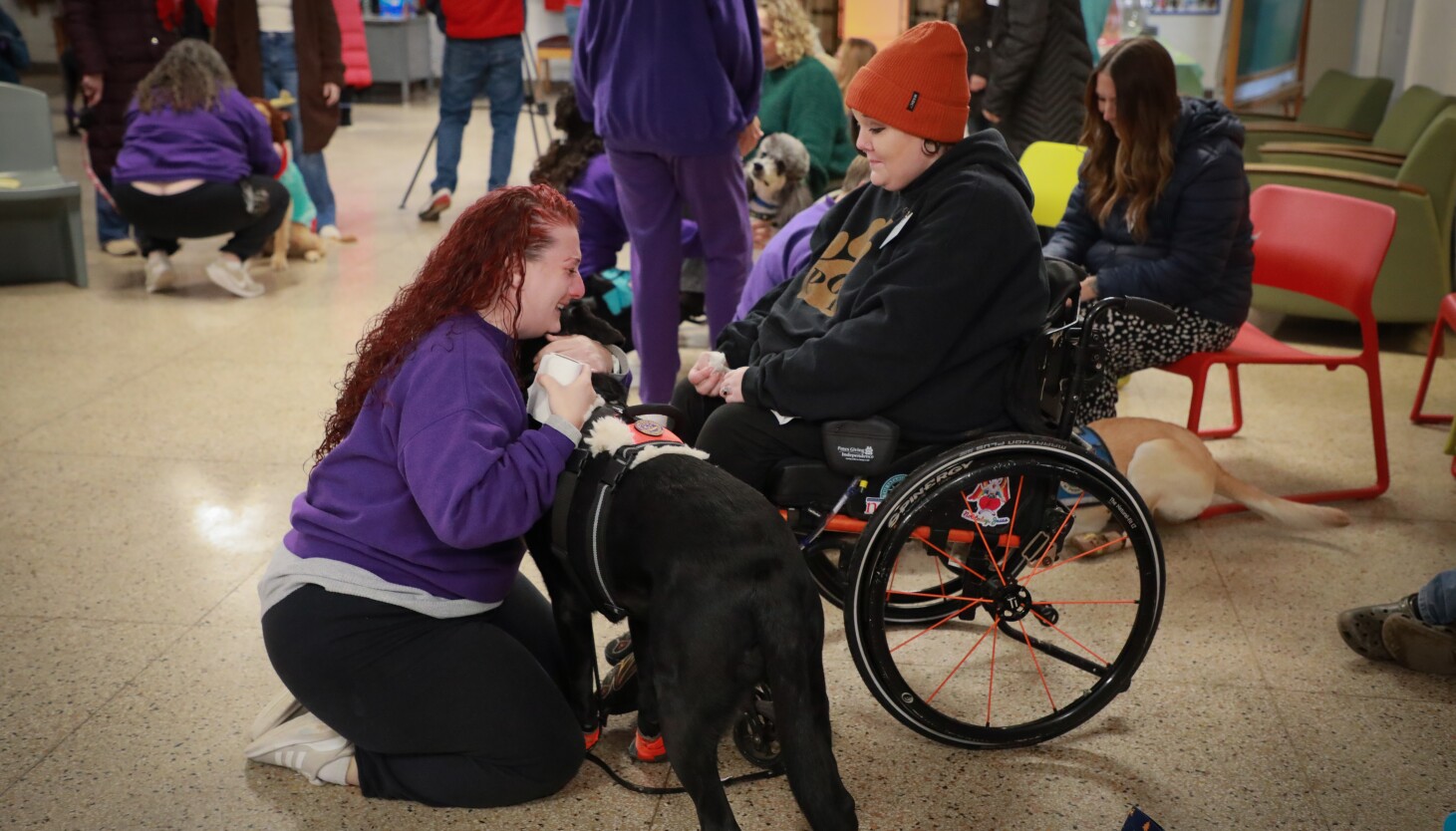
December means Christmas in the doggy day room at Logan Correctional Center, Illinois’ largest state prison for women.
On a recent visit, there were dogs dressed in holiday sweaters or reindeer antlers. Three pet crates, stacked in progressively smaller sizes, formed the shape of a Christmas tree.
And out on the floor, Blanca Solis showed off what her friend Teddy, a one-year-old Golden Retriever/Labrador mix, can do: He can sit. He can lift Blanca’s leg. He can take off her shoes with his canine teeth.
All of these are skills he may need when he finishes training at the prison and, hopefully, begins working as a service dog in the outside world.
“Knowing that I’m doing such a good thing and helping people… that’s what made me come to this program,” said Solis.

The gathering on Dec. 4, 2025 was a chance for the service dog trainers’ incarcerated at Logan Correctional Center to reunite with the dogs they helped train at the prison, and to meet their new owners.
Solis and Teddy are participants in Helping PAWS, a service animal training program run by Illinois Correctional Industries. The incarcerated trainers live in a designated wing of the correctional center, where they raise puppies from two local organizations: Paws Giving Independence and MidAmerica Service Dogs’ Foundation. Both are non-profits and run on donations.
Only 40 of the nearly 1,000 people locked up at Logan prison in Lincoln, Ill., are allowed to take part in Helping PAWS at any one time. Admittance is by application only. But for the handful of incarcerated people accepted into the program, it can be a lifeline.
“The prison system is not a nice place,” said Solis, who described herself as suicidal before she joined Helping PAWS. “Understanding that these dogs have the power to heal a person like me, I knew immediately the power they had to help a person outside in the world.”
The dogs live and train at the prison for about a year and a half. Then they get another year of outside training, according to Lisa Dial, the supervisor of the Helping PAWS program.
The goal is that the animals will work either as mobility assistance dogs or “facility dogs” that provide emotional support in hospitals or courtrooms. Meanwhile, the trainers can earn a certificate through the Department of Labor.
“It’s a good opportunity for these ladies to have something to do when they leave here,” said Dial.

Jessica Lighthart and Tara Morgan sit with dog Tibbs and its new owner, Kassidy Chenoweth. Kassidy is now 11, but was just 8 when she received Tibbs, making her the youngest recipient in the Helping PAWS program’s history.
During a recent visit, there was a special Christmas gift in store: Recipients of the service dogs reared at the prison were visiting, so they could meet the people who trained their dogs. It’s a spot of joy in a season that can be difficult and isolating for the more-than 29,000 people spending their winter holidays behind the walls of an Illinois state prison.
“What you do here doesn’t just change dogs, it changes lives,” dog owner Jamie Daniels told the group of incarcerated trainers. “Before Oliver came into my life, I spent almost two years mostly inside my house after my spinal cord injury.”
Daniels said her service dog, affectionately known as “Oliver the Magnificent,” has helped her pick up objects and re-enter public spaces.
“But most importantly, he has given me courage. Courage to show up, courage to be seen again, and courage to build a life beyond fear.”

Amber Cannella, right, is one of 40 people working as primary or secondary dog trainers in Logan prison’s Helping PAWS program. “The dogs helped me heal,” said Cannella.