
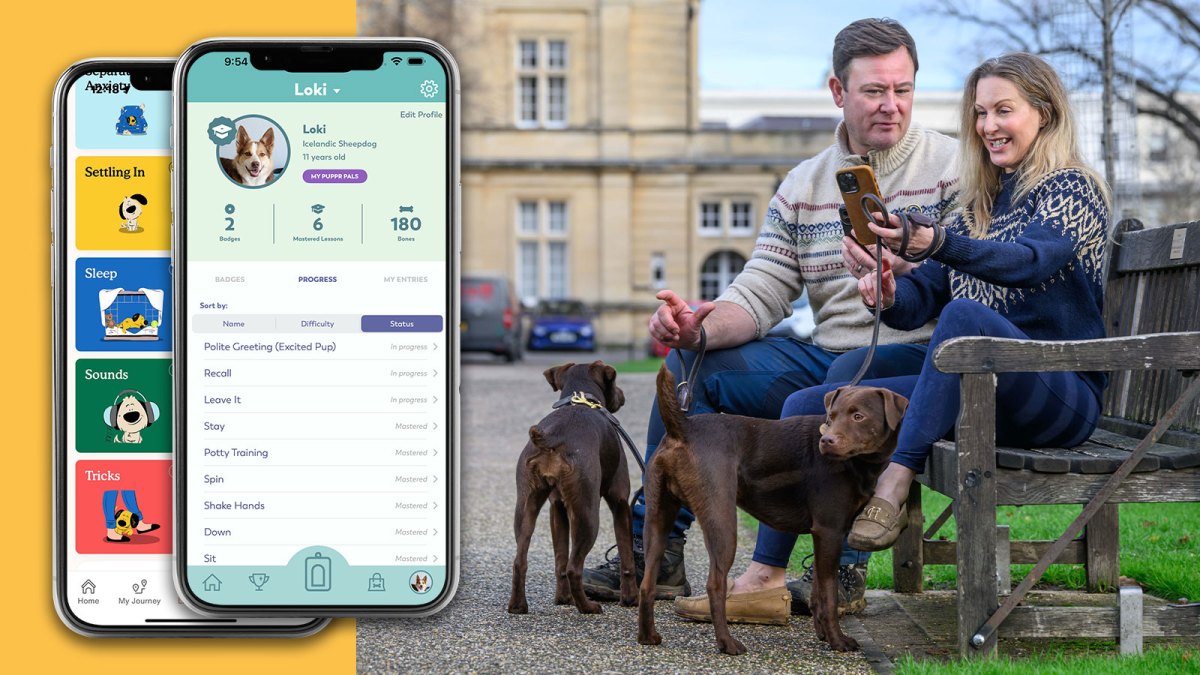
Angela Roberts, a hybrid-working business consultant from Cheltenham, was sitting on a critical call about raising equity for a startup when her two teething puppies started chewing the plaster off the wall.
There had been several moments of “overwhelm” since bringing siblings Molly and Rocco home at eight weeks old, causing her to consider which of the two she would be forced to give up.
Two years later, she sits beside both patterdale terriers, singing the praises of their transformative trainer: an app on her phone.
Roberts, 52, is one of thousands of dog owners turning to training apps, which were boosted by the “puppy pandemic”, a worldwide increase in puppy buying in 2020.
In-person training sessions came to a halt during the Covid-19 lockdowns (and are still recovering to prior participation levels).
After employees started returning to the office, the subsequent separation anxiety and problem behaviours of pandemic puppies created further demand for training solutions.
In October, the Dogs Trust received more than 3,000 handover enquiries, 28 per cent of which cited “unwanted behaviours” as a reason for giving up a dog.
A growing offering of apps, however, provides owners with bite-sized lessons, daily reminders and remote access to trainers from the comfort of their own home.
According to an autumn report by Business Research Insights, the global dog training app market is already worth more than $300 million and is expected to reach nearly half a billion by the end of 2026.
Zigzag, which Roberts used to train Molly and Rocco, has seen a revenue increase of 264 per cent since last year, with more than a million downloads of the app worldwide and 450,000 in the UK.
The app — which costs £29.99 a year — can tailor lessons to the breed and age of a dog, but specialises predominantly in the first year of training.
The most popular modules are the app’s noise socialisation lessons, which gradually expose puppies to sounds such as fireworks, emergency vehicles and doorbells.
Molly and Rocco’s owner also praised the app for its toilet training.

Modules available on the Zigzag app include Biting and Car Journeys
Although Roberts had owned dogs for 20 years, she had never tried to train two puppies at once and said they would repeatedly relearn bad habits from each other when she thought she had made progress. (The answer to the problem involved disguising the puppies’ accidents from each other using pet-friendly stain remover).
Roberts took the dogs to in-person training when they were old enough, but continued to consult the app about new adolescent behaviours, or in emergencies.
“We get compliments from friends when they come over and our dogs settle really well and sit in their place really beautifully,” she said, “but I’ll have them on the lead in the park and if there’s a squirrel, I mean … I wouldn’t say that I necessarily get complimented on those occasions.”
Roberts has now tailored the frequency of her notifications and searches for earlier content on the app using an AI tool.
Woofz, a European app which launched in 2020, also uses AI, with a virtual assistant available to answer questions at any time.
A breakdown of their users showed 44.4 per cent used the app for dogs under six months old (and 5 per cent of all users had dogs called Luna).
The app, which has 21 million downloads globally, including around 500,000 users in the UK. With an annual premium subscription at £57.99, Woofz saw its revenue jump from $5.2 million to $20 million last year.
Natalia Shahmetova, the co-founder and chief executive of Woofz, was confident in the app despite the competition in the market. “We believe that every competitor makes us stronger and has inspired us to deliver new features,” she said.
An alternative, earlier app in the United States, Puppr, was founded by Sara Carson shortly after performing a dance routine with her dog Hero on America’s Got Talent in 2017. It now has 2.6 million users including 130,000 downloads in the UK.
Dr Rowena Packer, a senior lecturer in companion animal behaviour at the Royal Veterinary College, estimated about 40 per cent of owners in the UK formally train their dogs.
Having studied the problem behaviour of pandemic puppies, she hoped this percentage would rise, perhaps aided by apps.
“Most dog training classes are training the owner to train the dog. So as long as the owner has access to information and education, that is the core of all of this,” she said, although added that owners should seek out science-based information from qualified trainers.
The Animal Behaviour and Training Council similarly said they “welcomed” technology which supports dog owners, but warned that dogs still needed socialisation.
A spokesman said: “The rise of these apps reflects an increasing demand for accessible and flexible training solutions, but it is essential that owners and guardians still seek professional guidance to ensure their dog has the best start in life.”