
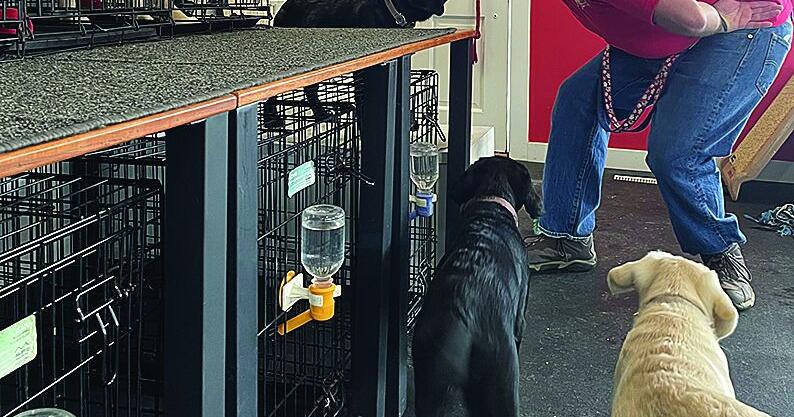
Every day, from 9 a.m. to 5 p.m., Carlos Zantizo and Ben Flagg work with a group of puppies, sometimes as many as five at a time. The two men are in almost-constant movement in a large room sectioned off with a thigh-high wall of child gates at Eyes Ears Nose and Paws in Hillsborough. They take turns leading the dogs in and out of two levels of pet crates, rewarding them with treats each time they lay down, or each time the door is closed.
While Flagg rotates two dogs from one crate to another, Zantizo takes the other three down a ramp and onto a bench in front of a window. Each dog sits and is quickly given treats. When the puppies are returned to the kennels, their cage doors are closed and Zantizo and Flagg step away, high-five each other, and return to the dogs to give them another round of treats.
A short time later, Zantizo will guide a puppy down the ramp and back onto the bench where he will sit with the dog and turn on a Dremel tool used for grinding nails. Dogs are introduced to blood pressure monitors and other home medical devices. They go outside for potty breaks and are led through other exercises and socialization meant to familiarize the dogs with their surroundings, other dogs and the staff.
This work with the dogs continues throughout the day. At 5 p.m., when the work with the dogs is finished and the training rooms are back in order, Flagg will drive himself home, but Zantizo will return to the Orange County Correctional Center where he is serving his prison sentence.
Zantizo is part of the At Both Ends of the Leash, or ABLE, program through Eyes Ears Nose and Paws and several prisons in North Carolina. EENP’s partnership with prisons focuses on producing skilled assistance dogs that someday will be matched with clients and, by design, ABEL gives the inmate-trainers the opportunity to improve their own lives. For Zantizo, getting involved with the program was, at first, a way to do something beyond the mundane routine of prison life.
“Now, I think what’s kept me around is seeing how much I’m learning, not just about dog training, but about myself,” he said. “At first it was like, get the dog to do something, give him a kibble. But now, I see it’s a relationship that I’m having with the dog, conversations without words, and just being able to see each dog individually. One, where they are in terms of training, and two, how can we find ways to communicate with one another, to pass certain obstacles.”
Learning from the dogs
But EENP isn’t just about training dogs to follow commands and to be faithful companions. That is part of it. The dogs that are trained and raised through the organization will become critical extensions of a client’s quality of life and safety. The commitment and relationships between the dog and person who receives the dog can last for beyond a decade. To be a part of making that happen is impactful, even for people who are paying for past mistakes.
“Being part of ABLE, I learned it’s not just about the dog, but the dogs are also teaching us,” Zantizo continued. “We’re teaching each other as well. Being out here on work release, I get to see the bigger picture, rather than just what’s happening inside of the prison training, where we get short stories or just snippets of what’s happening with clients after the dogs leave us. Now I get to see it real time.”
Eyes Ears Nose and Paws was founded in 2008, in Carrboro by Deb Cunningham and Maria Ikenberry. The two women had been volunteering with search and rescue groups, and Cunningham’s dog had been trained to find people lost in remote places, like heavily wooded areas. While they found the work rewarding, there were few viable professional options available for search and rescue dog teams.
“Deb started looking at other ways you can make a career out of this partnership between people and dogs, and assistance dog work rose to the top of that list,” said Ikenberry. “And at that point, we realized that there actually were no assistance dog organizations in the Triangle area, so it was either move to join one or start our own.”
According to the group’s website, since 2008, EENP has had 3,200 volunteers and partnered 98 dogs with clients. Each dog performs up to 50,000 hours of service in its lifetime. Dogs that now are in service catch more than 75,000 medical episodes in a year.
Finding dedicated trainers
For the first few years, Cunningham and Ikenberry ran EENP almost exclusively with the help of community volunteers, who raised the pups from the time they joined the training program up until the dogs were ready to graduate, a span of about 18 to 24 months, from birth to placement.
“So that’s almost two years that a single volunteer would have a dog, and that made it really hard to recruit volunteers who could make that long of a time commitment,” Ikenberry said. “That’s what got us to look into the prison dog training program and to start that partnership so we could bring more dogs into training.”
Simply in number of dogs that could be placed with clients, the impact of the ABLE program was huge. Prior to the change, EENP typically would place three or four dogs in a year. Now, the organization is placing between 12 and 15 dogs with clients in a year, which means more people with disabilities where a canine companion can make a difference are being served. And at the same time, the trainers in prison are able to experience an opportunity to redeem themselves.
“Our mission is partnering people with dogs to improve lives, and the primary way that we enact that is placing assistance dogs with people who have disabilities,” Ikenberry said. “The secondary way we enact that is that we work with the correction system to teach incarcerated men to train those assistance dogs.”
Recruitment for trainers is done through the prison system. Interested inmates must first meet a baseline of state requirements that include no sex offenders, a minimum sixth-grade reading level, and infraction-free for 90 days. After the initial screening for the baseline requirements, the prison will conduct a pre-interview, followed by an interview with EENP staff to make sure the potential trainer is a good match.
“We’re looking for someone who is able to see outside themselves,” Ikenberry said. “The dogs are a catalyst for change for the trainers who are in the program. That by itself, is a huge part of what we do, but the incarcerated trainers are in service of the end goal of getting the dogs to clients whose lives will be changed by those placements.”
Most of the dogs that go through the training program at EENP are born within the organization. EENP is a member of a breeding cooperative of assistance dog schools throughout North America. From time to time, an EENP dog will have a litter of puppies.
“We host that litter and raise them up,” Ikenberry said. “Some of the dogs leave after eight weeks, but most of them will stay with us and become the dogs that are in training to become assistance dogs.”
At eight weeks, the puppies will undergo a selection process to determine which of the dogs will stay at EENP, and which will move on to young puppy trainer homes — community volunteers who each have one dog in their home that they are raising, socializing and providing first-level training for the dog.
“They’re not doing any cue-based training, so they’re not teaching commands,” she said. “They’re doing things like making sure that the dogs are comfortable being left alone for a period of time, that they have met a ton of different people, and that they’re confident, happy, secure dogs. That’s a huge focus of their work.”
Variety of training experiences
Being exposed to a variety of environments and experiences at a young age is crucial for the puppies. It’s also why the dog training at the prisons does not begin for a dog until it is at least six months old. Once the dog is between six and nine months old, EENP holds what it calls a Leash Ceremony for the puppy that is entering the ABLE training.
“That’s where all of the advanced training happens,” Ikenberry said. “The trainers in prison start with your basic sit, down, stay, come, things that regular pet dogs are also learning. But then they move on through what we would call advanced skills, which are the assistance dog skills.”
That involves teaching the dogs to retrieve items, open doors, get help, work with wheelchairs, site detection work that medical alert clients need. Nearly all the skills that are needed to provide for disabled clients are introduced in prison.
But there are some skills that a dog cannot learn in a prison, like navigating a restaurant, busses, a swimming pool or an elevator. To gain experiences beyond what the limited prison environment can provide, the dog will have a “furlough” week.
“One week out of every four, the dogs rotate out of the prison,” Ikenberry said. “On any given week, 25 percent of the dogs that are assigned to ABLE are not in ABLE. They are out in the community. During those furlough weeks, they are with either a volunteer trainer or one of our staff members.”
Generally speaking, the dog will be in the prison-based program all the way until it’s ready for placement with a client. They are not with the same trainer the entire time. Every four months, as new dogs are brought in during the Leash Ceremony, the dogs already in the program are rotated to different trainers.
“By the time the dog is ready to graduate, it’s had three or four different primary trainers,” Ikenberry said.
EENP is largely funded by donations. The organization charges $20,000 for the placement of the assistance dogs.
“It doesn’t cover anything close to the full cost of the training and placement,” Ikenberry adds. “But for us, there are two parts to it: One is that when we have clients who are in fact able to afford to contribute to the cost, it seems unfair to be asking the public to fund it when somebody can themselves contribute.”
The second part is, even for folks who themselves are unable to contribute to the cost of the assistance dog, there are other ways they can make some kind of a financial commitment, whether that’s engaging the community to help or looking for grants.
“Making some kind of financial commitment to the placement is pretty important, we feel, to the success of the placement,” Ikenberry said.
The client process at EENP begins with an application, followed by an interview to understand what the client needs in a placement. The applicant is then placed on a waiting list.
EENP dogs learn to use their bodies in ways that become building blocks for complex skills. A nose push becomes the basis for several behaviors, from alerting with a nose bump to activating a crosswalk button with its nose. This makes the initial training for all EENP dogs similar, whether the dog is destined to become Mobility Service Dogs or Medical Alert Dogs, regardless of the client they will be matched with.
Medical Alert Dogs are also trained to detect one or more target scents, such as diabetic blood sugar highs or lows. That training begins with simple exposure to the scent and encouragement when the dog pays attention to the scent. The training progresses through a series of steps where the dogs learn to link the smell with an alerting behavior, typically a nose bump, as well as other behaviors such as going to get help.
Client/dog relationship
“We don’t train a specific dog for a specific person,” Ikenberry said. “We bring the dogs up and as a dog is getting ready for placement, we start to think about which of our clients could be a good match for this dog. Part of the reason we don’t train a dog for a particular person, is that as the dog matures, it can become a different dog.”
Clients at the top of the waiting list will be invited to EENP, which recently moved to a larger location in Hillsborough, for a meet-and-greet. The client and the dog will spend about three hours working together and going through a few exercises.
“Ideally, we’ll have two or three dogs that a person might be able to match with,” Ikenberry said.
After a service dog is matched, EENP will spend two weeks working with the dog and the client to make sure the new partnership is working as it should. For the first year of the placement, EENP works closely with the client, meeting with them multiple times a month to provide what it calls aftercare.
“The dog will pass some evaluations when they graduate,” Ikenberry said. “We want to let three months pass after graduation because that’s kind of the degrading time, and then they need to pass those evaluations again. So we’re working very closely with them to be sure that they are able to get back to that point where they’re able to pass those evaluations again.”
Most of the time, the dogs that are matched with the clients become an invaluable resource and enabler for the person. The animal’s companionship provides a level of independence and confidence to the disabled client that in some ways mirrors the changes undergone by the incarcerated trainers in the ABLE program.
Worthwhile work
“Imagine being incarcerated, and being able to work with an animal you love, and then knowing what you’re doing is helping others who can’t help themselves,” said Flagg, who is no longer in prison and is now a full-time employee at EENP. “This program was an anchor for me. An anchor in a dark time. I came into this thinking I would be training dogs, but I have learned so much from them.”
“I never wake up in the morning wondering if what I do matters,” Ikenberry said of her work at EENP. “I have the great privilege of knowing, without a doubt, that what I do is impacting many people in a really positive way. There are times when it’s exhausting. There are times when I feel like I’m not the best suited to the job, but I always feel blessed to have the job. I mean, we all have to work for money, and to be able to earn a living doing something that feels so powerful is a really lucky thing.”
To learn more about Eyes Ears Nose and Paws, go to eenp.org