
Not far from Leamington Spa, nestled among Warwickshire fields, sits the headquarters of Guide Dogs, Britain’s best-known working-dog charity. On a winter morning it feels rather like a nursery. Young labradors and retrievers race around their pens, round-eyed and disarmingly earnest.
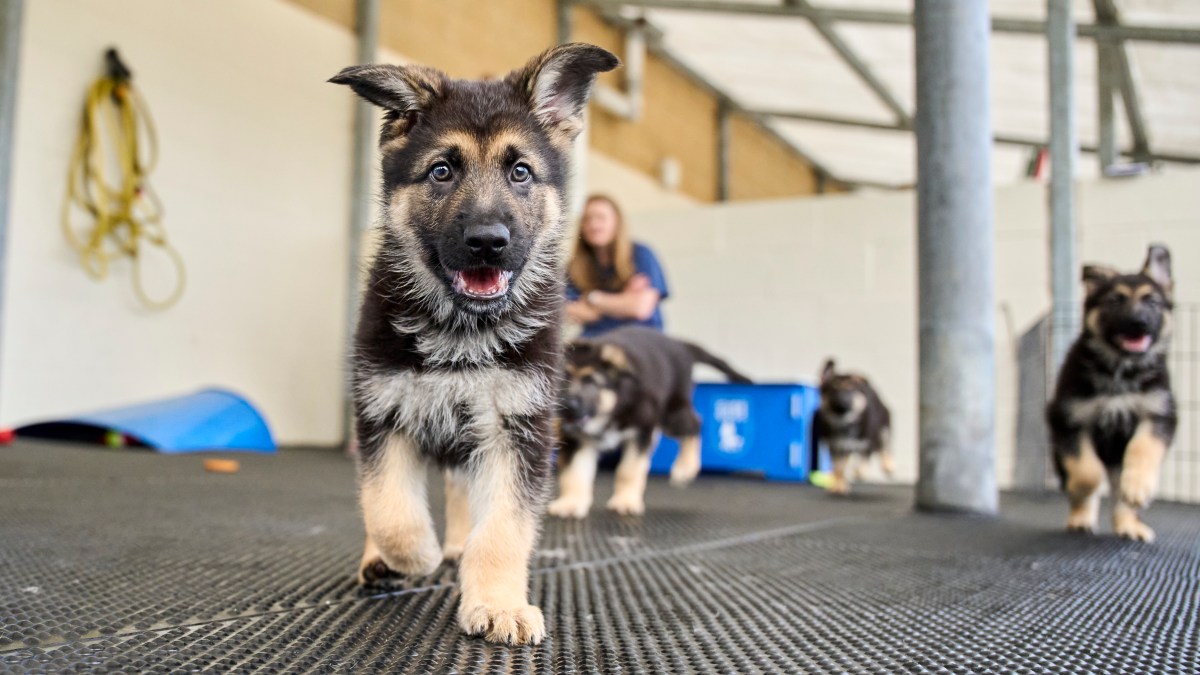
In one enclosure, though, is a rarer sight: half a dozen German shepherd puppies tumbling over each other, all ears, paws and mischief.
German shepherds account for just 4 per cent of guide dogs in Britain. But these six — there are five brothers, Kobe, Khade, Keltie, Kerby and Millet, and a single girl, Keziah — stand out for another reason. They are some of the newest participants in a pioneering effort to answer a deceptively simple question: how much of a dog’s temperament is written in its genes?

The litter’s sire had a calm and reliable nature
OLI LEES FOR THE TIMES
This litter is “monumental”, a spokeswoman said. German shepherds are best known for roles such as police, military and security work, where high drive, vigilance and a readiness for controlled aggression are often prized.
Guiding demands a different skillset: steadiness, calmness and an indifference to distraction.
To widen its German shepherd gene pool, Guide Dogs collaborates internationally with other organisations. The sire of this litter, Hardy, came from The Seeing Eye in New Jersey, the first guide-dog school outside Europe. Although Hardy has been dead for more than five years, he lives on via frozen semen.
He has been exceptionally successful, siring 41 qualified guide dogs, owing largely to his calm and reliable nature. The mother of his latest litter, Columba, gave birth in August in Britain after artificial insemination and raised her puppies at home with a Guide Dogs volunteer nearby.
Her sons may yet become stud dogs themselves, helping secure the future of German shepherd guide dogs in Britain. But they will also be part of another programme, an effort to untangle the role played by genes on behaviour.

The invention of fast and relatively cheap genetic sequencing has already allowed Guide Dogs to make strides towards avoiding unwanted physical traits, such as fragile hips and elbows, and health conditions such as skin diseases.
The next frontier involves behaviour. To what extent can genetics shed light on why one puppy will thrive in a harness while another, apparently similar dog will find the job stressful or unrewarding?
Guide Dogs is uniquely well-positioned to answer that question. At the heart of its approach is a detailed puppy behaviour questionnaire completed when its dogs are five months old. It runs to 39 questions aimed, in part, at measuring traits such as excitability, anxiety and focus. “We currently have just under 4,000 of these questionnaires, spanning multiple generations,” said Becky Hunt, the charity’s breeding programme data manager.

Becky Hunt
OLI LEES FOR THE TIMES
Using sophisticated statistical techniques, Hunt and her colleagues have calculated estimated breeding values, scores that predict the part played by genetics on traits such as the ability to concentrate on a task.
The method is borrowed from livestock breeding. Dairy bulls, for example, are judged by the milk yields of their daughters. If hundreds of daughters outperform those of another bull across many different farms, genetics is believed to be playing a role. In dogs, pedigrees provide the family tree, behaviour scores provide the data.
The results are already revealing and perhaps slightly counterintuitive. Behavioural traits, the data suggests, are only slightly heritable. In German shepherds, only about 15 to 20 per cent of the variation seen in the behavioural data in traits such as “general anxiety” or “excitability” are believed to be down to genes.

Decades of selective breeding have made German shepherds bred to be guide dogs calmer — but nurture is vital
OLI LEES FOR THE TIMES
Similar results have been seen in the charity’s labradors and golden retrievers. This does not mean genetics are unimportant. Hunt said that it highlights how powerful the environment is in shaping behaviour. It seems that early experiences, handling and training matter enormously.
“Raising our puppies appropriately has a huge influence,” Hunt said. Paradoxically, low heritability can make this kind of analysis more useful. If the environment strongly influences behaviour, then judging dogs purely on what you see risks missing the genetic component.
Estimated breeding values help tease out genetic signals from environmental noise, allowing breeders to make small, cumulative improvements over generations.
Even within a single breed, divergence can be dramatic over time. German shepherds bred to be guide dogs may look similar to their police dog peers, but decades of selection have made them markedly different: calmer and less confrontational.
“Estimating genetic relationships is a powerful tool in understanding the deeply complex jigsaw that makes up the best guide dog puppies, ones that are not only physically healthy but mentally suited to the role,” Tom Lewis, the breeding and genetics lead at Guide Dogs, said.
“Continuous advancements in our breeding allow us to build a strong foundation to each new guide dog partnership. The data we collect can even be used in understanding the wider dog population.”
Meanwhile, by now Kobe, Khade, Keltie, Kerby, Millet and Keziah (litters are named on an alphabetical basis, with exceptions made for puppies that are sponsored by members of the public) will have left the Guide Dogs headquarters to live with volunteer puppy raisers across the country.
They will spend roughly a year with these foster families, learning about the human world. Several should go on to be guide dogs. A few may shape future generations through breeding. All will contribute data to a growing experiment in understanding temperament.