
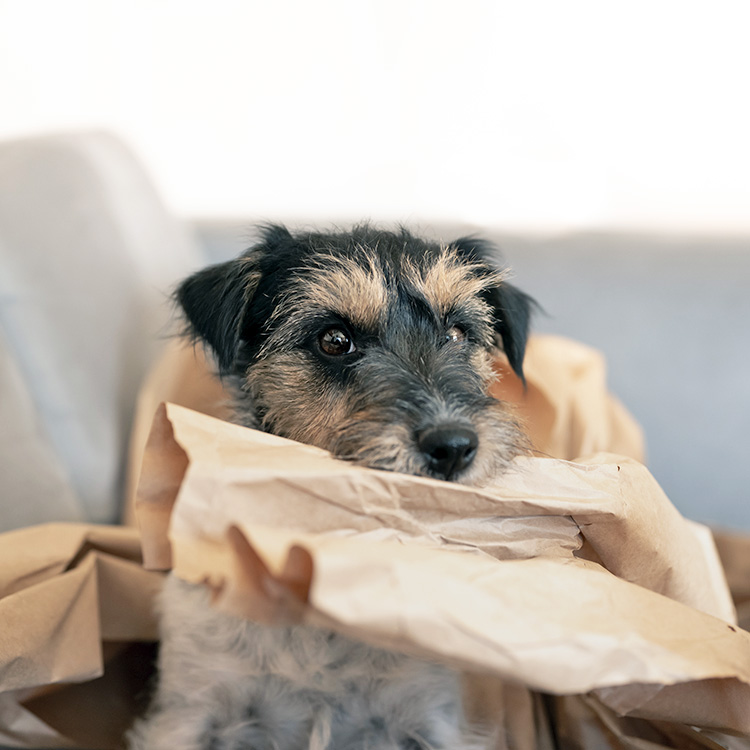
Growing up, our family dog, Sandy, had one clear favorite day of the year: Christmas morning. Her excitement for this holiday was not caused by the toys she got or the treats we sneaked to her from the dinner table. The main event was when everyone opened presents and the endless supply of paper it provided her to rip and chew.
But why do dogs love ripping apart paper? The reasons are complicated but largely come down to long-engrained instincts and a desire for sensory play, says Sian Lawley-Rudd, ethical dog trainer and trauma-informed coach from Lavender Garden Animal Services.
“Ripping things is a natural outlet for dogs,” she says. “It taps into instincts around foraging, dissecting, and exploring different textures, and paper gives them instant, satisfying feedback. It tears easily, it makes noise, and the end result looks like they’ve really ‘achieved’ something.”
In addition to evolutionary satisfaction, ripping paper is also a way for dogs to better understand their environments, says Frankie Jackson, a certified trainer and canine behavior consultant at Canine Counseling.
“Puppies, in particular, explore their world with their mouths, so shredding can start as curiosity and become habit if it’s rewarding,” she says. “Often this happens if the owner accidentally reinforces the behavior by chasing, yelling, or even picking the puppy up — all of those things are attention, and attention is a great reinforcer even when we intend it to do the opposite.”
Nobody enjoys experiencing the cartoon cliché of their dog ripping up the morning newspaper — but before you go chasing your pup down for shredding, you should know it can also be a positive outlet for their needs, Jackson says. They just need the right materials.
“When done safely, shredding can be an enriching activity that provides mental and physical stimulation,” she explains. “For dogs with strong prey or foraging drives, giving them a stack of old newspapers, junk mail, or an old cardboard box to tear up can satisfy these instincts without causing damage to the home or personal items.”
If you notice your dog is shredding paper or ripping up things they shouldn’t, be sure to look at the root causes, Lawley-Rudd advises. Shredding can be a way to release tension, “especially for dogs who get overwhelmed or don’t have many other calming outlets during the day,” she says. That’s because dogs often use their mouths to decompress. In addition to stress or overwhelm, your dog who is shredding paper may just be bored, she added.
In other words, not all paper shredding from our pups is as joyful as it is on Christmas morning. Some pet parents get frustrated inappropriate forms of ripping and shredding. So, how do you know if the paper shredding is actually a problem?
Compulsive shredding
If shredding happens obsessively, compulsively, repetitively, or for long periods and can’t be interrupted easily, you may have a bigger problem. Dogs often develop compulsions due to stress, or if they start a bad habit at a young age and it is not properly trained out of them, Jackson says.
Stress-related behaviors around shredding
If your dog seems tense, frantic, or unable to settle before or after shredding, it may suggest panic or anxiety. Jackson says experts often see such behavior in crated dogs who have separation-related distress.
This is particularly concerning when accompanied by behaviors that suggest a dog is suffering from stress, like pacing, whining, destructive chewing of furniture, or self-injury. “It can also be emotional overflow, or ‘overarousal’, where the dog just has no other reasonable energy outlet,” she adds.
Attention seeking
If dogs are repeatedly targeting important items like bills, homework, or other sentimental papers, they may be trying to get your attention. That isn’t because they can read the words on it and know it is homework; dogs don’t know how to punish you! Instead, it’s likely that you are inadvertently reinforcing such actions, Jackson says.
“They’re specifically using a behavior that they know will get them attention, even if it’s negative,” she says. “We see this with pups who lack proper enrichment outlets — both mind and body — and those suffering emotional or social neglect.”
Lawley-Rudd agrees that paper ripping can become a problem if the dog is eating the paper rather than just shredding it, if it’s happening obsessively, or if it’s clearly being driven by stress or frustration.
“In those cases, it’s worth looking at what emotional need the behavior might be meeting,” she says. “If the shredding is happening because of stress, it’s about widening their whole emotional toolkit, more calm outlets, predictable routines, and activities that help regulate their nervous system so the shredding isn’t their only coping strategy.”
Lawley-Rudd recommends that instead of trying to stop paper shredding completely, dog parents offer more appropriate outlets, like Christmas wrapping paper saved specifically to be destroyed, cardboard boxes with treats hidden inside, toilet-roll tubes stuffed with food, or other DIY enrichment toys, like paper “parcels.” For example, you can try giving them scrunched-up newspaper with food sprinkled inside.
“By giving dogs a safe, structured way to shred, you meet the need without losing your important documents or tissues,” she says.