
What Were Cavalier King Charles Spaniels Originally Bred For?
Cavalier King Charles Spaniels were originally bred primarily as companion dogs for royalty and the British aristocracy. They were prized as affectionate lapdogs, but their spaniel ancestry also gave them sporting instincts, and some of the larger dogs were used to flush birds and other game.
This combination helps explain the modern Cavalier perfectly. They are affectionate dogs that love being close to people, yet many are surprisingly energetic when they get outdoors.
Their story also involves royal palaces, old paintings, hunting dogs and an American who helped revive a type of spaniel that had almost disappeared.
Let’s take a closer look.

What Were Cavalier King Charles Spaniels Bred For?
The main purpose of the ancestors of today’s Cavalier King Charles Spaniel was human companionship.
Small toy spaniels became fashionable amongst European nobility centuries ago and were particularly associated with the English royal court during the 17th century.
They were small enough to sit comfortably on a person’s lap and were valued for their affectionate temperament and willingness to remain close to their owners.
However, there was still a working spaniel hiding beneath the aristocratic exterior.
Some of the larger and sturdier toy spaniels retained the instincts of their sporting ancestors and could accompany people into the countryside and flush birds.
So, if you’re looking for the simplest answer:
The Cavalier’s main historical job was being a companion and lapdog, although its ancestors also had sporting ability and some were used for flushing game birds.
Cavalier King Charles Spaniel original purposes at a glance
| Purpose | Importance |
|---|---|
| Companion dog | Primary role |
| Royal and aristocratic lapdog | Primary role |
| Lap warmer | Traditional role |
| Flushing game birds | Secondary role for some dogs |
| Modern family companion | Main role today |
That combination of companionship and sporting ancestry can still be seen in Cavaliers today.
Were Cavalier King Charles Spaniels Hunting Dogs?
This is where the history becomes particularly interesting.
Calling the Cavalier simply a hunting dog would be misleading. They weren’t developed for serious fieldwork in the way that breeds such as English Springer Spaniels and working Cocker Spaniels were.
But it would also be wrong to say hunting played no part in their history.
The Cavalier’s ancestors came from sporting spaniel stock.
Historically, litters could produce smaller dogs particularly suited to life as lapdogs alongside larger, more robust dogs that retained enough sporting ability to go into the field.
The red-and-white spaniels associated with the Dukes of Marlborough at Blenheim Palace are particularly interesting.
These dogs weren’t merely decorative pets. They retained sporting instincts and were known for their ability to flush game.
The Royal Kennel Club specifically notes that the first Duke of Marlborough developed the red-and-white Blenheim Spaniel, which was adept at flushing game.
That’s an important part of Cavalier history that’s easily overlooked when we see today’s little dog curled up comfortably on the sofa.
Although primarily companions, Cavaliers retain genuine sporting instincts. If you’re interested in this side of the breed, find out more about whether Cavalier King Charles Spaniels can hunt.
Why Are They Called Cavalier King Charles Spaniels?
The name comes from the breed’s close association with the Stuart monarchy, particularly King Charles II of England.
Charles II was famously devoted to his little spaniels.
They appear repeatedly in paintings and accounts of the period and became so closely associated with the king and his court that his name became permanently connected with the dogs.
The word Cavalier, however, came later.
It was introduced to distinguish the revived, longer-muzzled dogs resembling the spaniels of Charles II’s era from the shorter-faced King Charles Spaniel.
That distinction is important because the Cavalier King Charles Spaniel and King Charles Spaniel are separate breeds today.
The Royal History of the Cavalier King Charles Spaniel
Small spaniels can be seen alongside European aristocrats in paintings dating back centuries.
During the Tudor and Stuart periods, these dogs became particularly fashionable as companions.
They weren’t expected to guard an estate, herd livestock or spend all day working in a field.
Their most important job was much simpler:
stay close to people.
Their small size made them convenient household companions, while their friendly nature made them suitable for the intimate environment of royal and aristocratic homes.
They were also traditionally described as lap warmers.
In an age before central heating, it’s not difficult to understand the appeal of having a warm little spaniel curled up on your lap.
King Charles II and His Spaniels
No monarch is more closely associated with these dogs than Charles II.
The king was renowned for his affection for his spaniels, and historical accounts describe dogs accompanying him as he went about his daily life.
That royal connection did more than give the dogs a memorable name.
It helped turn the little spaniel into an instantly recognisable symbol of Restoration England.
Look at portraits from the period and you’ll notice something interesting, though.
Those dogs don’t look exactly like the King Charles Spaniel that subsequently became fashionable.
They generally have longer muzzles and flatter skulls.
That difference would eventually become extremely important.
How the Original Spaniel Changed
Dog fashions change just like human fashions.
Over the following centuries, British dog enthusiasts increasingly favoured toy spaniels with shorter muzzles and more rounded heads.
Crossing and selective breeding produced a much flatter-faced dog.
By the Victorian period, the little spaniels appearing in the show ring looked noticeably different from those shown alongside Charles II in old paintings.
The longer-faced type had almost disappeared.
Today’s King Charles Spaniel developed from this shorter-faced type.
The story might have ended there if it weren’t for an American named Roswell Eldridge.
How Roswell Eldridge Helped Revive the Cavalier
In the 1920s, Roswell Eldridge visited Britain looking for the type of spaniel he had seen depicted in old paintings.
He struggled to find them.
So he offered prize money at Crufts for breeders who could produce Blenheim Spaniels of the old type — dogs with the longer face and flatter skull seen in paintings from the era of Charles II.
The challenge encouraged breeders to recreate and preserve that older appearance.
In 1928, enthusiasts formed a breed club, and a dog called Ann’s Son became an important model for the developing breed standard.
The word Cavalier was adopted to distinguish these dogs from the shorter-faced King Charles Spaniel.
In other words, the modern Cavalier King Charles Spaniel isn’t simply an unchanged dog that has existed since the days of Charles II.
It is better understood as a 20th-century revival of the older-style toy spaniel depicted in historic paintings.
What’s the Difference Between a Cavalier King Charles Spaniel and a King Charles Spaniel?
The names make this confusing, particularly for people encountering the breeds for the first time.
They are closely related, but they are not the same breed.
The Cavalier King Charles Spaniel is generally the larger of the two and has a longer muzzle and a relatively flat skull.
The King Charles Spaniel — called the English Toy Spaniel in the United States — has a shorter muzzle and a more domed head.
The Cavalier was deliberately developed to resemble the earlier type of spaniel seen in paintings from the time of Charles II.
Where Does the Blenheim Cavalier Get Its Name?
One of the best-known Cavalier colours also has a historical connection.
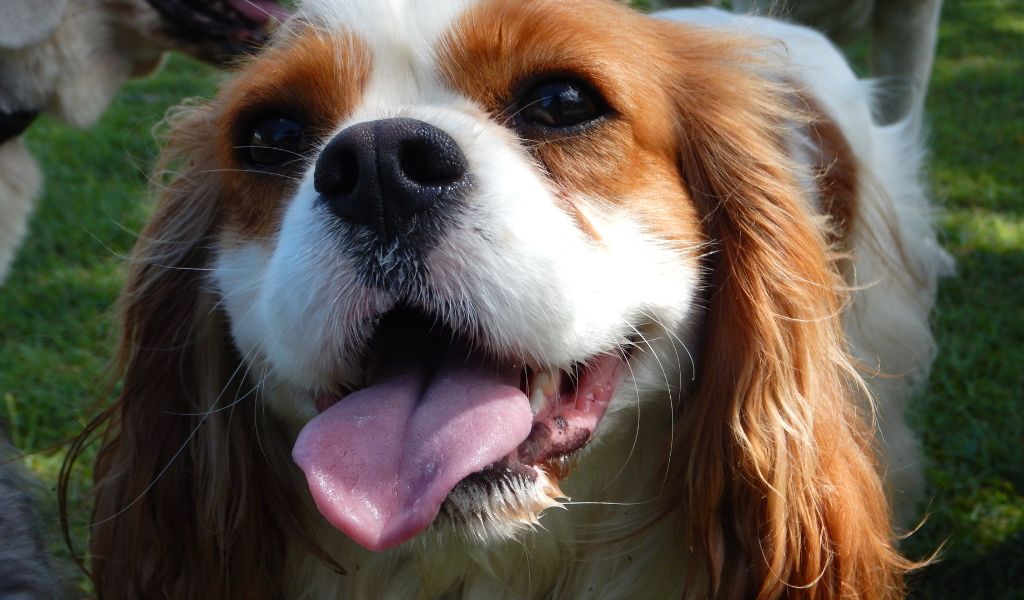
Blenheim describes the Cavalier’s chestnut-and-white colouring.
The name comes from Blenheim Palace, home of the Dukes of Marlborough.
The Marlborough family maintained a line of red-and-white spaniels that became known as Blenheim Spaniels.
These dogs are particularly significant because they demonstrate the Cavalier’s dual heritage.
They could be treasured household companions while still retaining enough sporting instinct to flush game.
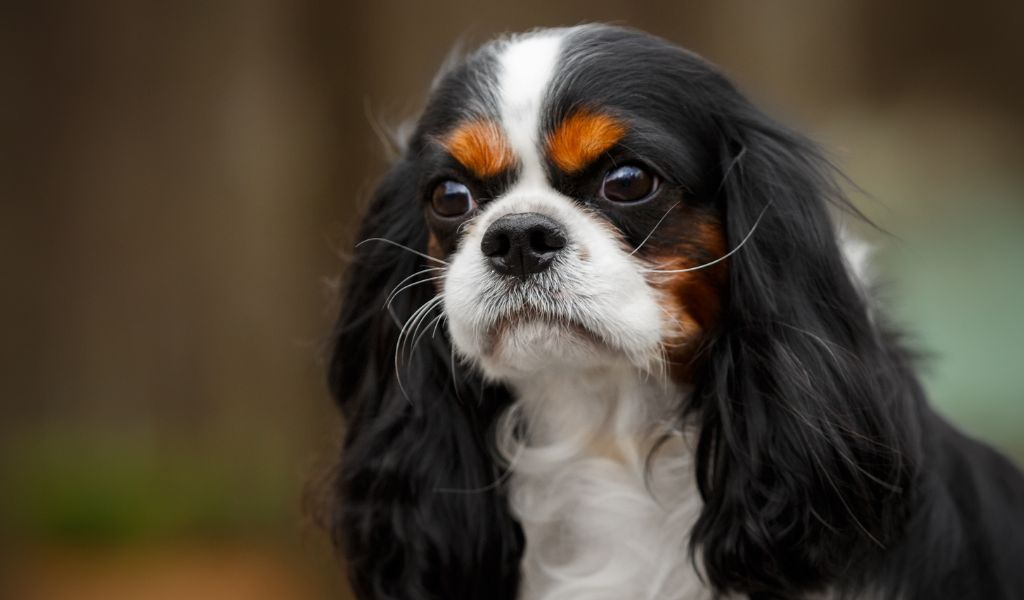
Today’s Cavalier King Charles Spaniel is recognised in four colours:
- Blenheim — chestnut and white
- Tricolour — black, white and tan
- Ruby — rich red
- Black and tan
How Their Original Purpose Influences Cavaliers Today
You can learn a lot about a dog’s behaviour by looking at what generations of its ancestors were selected to do.
With Cavaliers, two characteristics stand out.
They want to be with people
A dog developed largely for companionship was never supposed to spend most of its life away from humans.
That helps explain why many Cavaliers are happiest following their owners around the house, sitting beside them and being involved in family life.
Their affectionate nature isn’t an accidental feature of the breed.
Companionship is part of their heritage.
It also means that anyone considering a Cavalier should think carefully about how much time the dog will routinely spend alone.
They still have spaniel instincts
Don’t let the lapdog appearance fool you.
The Cavalier still has spaniel ancestry.
Many Cavaliers enjoy exploring outdoors, investigating interesting scents and chasing birds or other small animals.
Individual dogs vary considerably, but seeing a Cavalier suddenly become very interested in something moving through the undergrowth shouldn’t be particularly surprising.
There’s a sporting dog somewhere in that family tree.
Their history as companion dogs still has a strong influence on the Cavalier King Charles Spaniel’s temperament and training needs.
Are Cavaliers Still Working Dogs Today?
Cavaliers are overwhelmingly kept as companion dogs today rather than traditional working spaniels.
Their affectionate temperament and manageable size make them popular household pets.
They’re also intelligent enough to enjoy activities such as obedience, rally and agility.
For most owners, though, the Cavalier’s modern “job” is remarkably similar to its historical one:
being close to its people.
That’s perhaps why the breed has made the transition from royal court to modern living room so successfully.
Does Their History Make Cavaliers Good Family Dogs?
Their companion heritage certainly helps.
Cavaliers have been selected over generations for characteristics that work well in a companion animal, including sociability and affection towards people.
However, breed history shouldn’t be used as a guarantee of an individual dog’s personality.
Good breeding, early socialisation, appropriate training, exercise and the dog’s individual temperament all matter.
Prospective owners should also research the breed’s health carefully and choose breeders who carry out the appropriate health screening.
Frequently Asked Questions
What were Cavalier King Charles Spaniels originally bred to do?
Cavalier King Charles Spaniels were primarily developed as companion and lap dogs for royalty and aristocratic families. Their ancestors also retained sporting instincts, and some of the larger dogs were used to flush game birds.
Were Cavalier King Charles Spaniels bred for hunting?
Not primarily. Cavaliers belong to the toy spaniel tradition and were valued mainly as companions. However, they descended from sporting spaniels, and historical dogs — including Blenheim Spaniels — could be used to flush birds.
Were Cavaliers bred to be lapdogs?
Yes. Companionship and life as lapdogs were major historical roles of the small toy spaniels from which the modern Cavalier developed.
Why were Cavalier King Charles Spaniels popular with royalty?
Their small size, affectionate temperament and attractive appearance made toy spaniels well suited to life as close companions within royal and aristocratic households. They became particularly associated with King Charles II.
Did King Charles II create the Cavalier King Charles Spaniel?
No. Charles II was famously associated with small toy spaniels, but the modern Cavalier King Charles Spaniel was developed much later. In the 1920s, breeders began deliberately restoring the longer-muzzled, flatter-skulled type depicted in paintings from Charles II’s era.
When was the modern Cavalier King Charles Spaniel developed?
The revival began during the 1920s after Roswell Eldridge offered prizes at Crufts for spaniels resembling the “old type” depicted in historic paintings. A breed club was established in 1928.
Why are chestnut-and-white Cavaliers called Blenheim?
The name comes from Blenheim Palace, where the Dukes of Marlborough maintained a line of red-and-white spaniels. Chestnut and white remains one of the four recognised Cavalier colours.
Do Cavalier King Charles Spaniels still have hunting instincts?
Some do. Cavaliers retain spaniel ancestry, so behaviours such as following scents, investigating cover and chasing birds can occur. The strength of these instincts varies between individual dogs.
What is the difference between a King Charles Spaniel and a Cavalier King Charles Spaniel?
They are separate but closely related breeds. Cavaliers are generally larger and have a longer muzzle and flatter skull, reflecting the older type of toy spaniel that breeders sought to restore during the 20th century.
Final Thoughts
So, what were Cavalier King Charles Spaniels originally bred for?
Above everything else, they were companion dogs.
Their ancestors shared the homes and laps of aristocrats, became famously associated with King Charles II and were valued for their affectionate relationship with people.
But there’s another side to the story.
These little dogs came from sporting spaniel stock, and some retained enough working ability to flush game birds. That heritage hasn’t entirely disappeared.
It helps explain why the modern Cavalier can spend one minute happily curled up beside you and the next enthusiastically investigating every scent on a country walk.
Perhaps that’s the best way to understand the breed.
The Cavalier King Charles Spaniel is a companion dog with a spaniel’s heart — bred to stay close to people, but with just enough sporting heritage to remind you where it came from.