

Knowing how to train a working Cocker spaniel puppy is well within the ability of anyone, as long as you take your time and try to think dog at every stage. Begin your Cocker spaniel training early, always be consistent with your puppy, don’t rush and take your time. Puppies are baby dogs and learn at varying rates according to their personality.
How to Train a Working Cocker Spaniel Puppy
This podcast offers an in-depth discussion about working Cocker Spaniel puppies. It starts by stressing the importance of early training and consistency, while highlighting the breed’s intelligence and high energy levels. You’ll learn about basic training commands such as walking on a lead, coming when called, sitting, and retrieving. The episode focuses on positive reinforcement and building trust by understanding the dog’s perspective. It also covers the significance of playtime and exposure to various environments for well-rounded development.
Working Cocker Spaniels are intelligent, energetic and remarkably quick learners. Start your puppy’s training early, keep sessions short and enjoyable, and concentrate on the basics before worrying about advanced gundog work.
The first things I want a working Cocker puppy to learn are simple: his name, coming when called, sitting, walking on a lead and retrieving. I also want him to become confident around me and to regard being with me as a good place to be.
Don’t be in a hurry.
A young Cocker Spaniel puppy doesn’t need hours of formal training. In fact, you’ll often achieve far more with a few minutes of enjoyable training than you will by drilling a puppy until he’s bored.
I’ve been around dogs and spaniels for many years, and one of the most important things I’ve learned is that training a working Cocker puppy should feel more like structured play than work.
Get the foundations right while your puppy is young and you’ll make the more advanced training much easier later.
Working Cocker Spaniel puppy training at a glance
If you’ve just brought your puppy home and are wondering where to begin, this is the general progression I recommend:
| Puppy stage | What to concentrate on |
|---|---|
| From arriving home | Bonding, name recognition, toilet training and establishing a routine |
| 8–12 weeks | Recall games, sitting, handling, confidence and simple retrieving games |
| 3–4 months | Lead walking, recall, whistle association and retrieving |
| 4–6 months | Strengthening recall, steadiness, confidence and basic whistle work |
| Around 6 months onwards | Gradually progressing towards more structured working and gundog training when the puppy is ready |
These ages are a guide, not deadlines.
Every puppy develops differently. One Cocker may grasp an exercise almost immediately while another needs considerably more time.
Train the puppy in front of you rather than the puppy you think you should have.
When should you start training a Working Cocker Spaniel puppy?
Training can begin as soon as your puppy has had time to settle into his new home.
That doesn’t mean taking an eight-week-old puppy into a field and beginning serious gundog training.
At this age, almost everything can be taught through everyday life and play.
Calling his name before feeding him is training.
Encouraging him to follow you around the garden is training.
Waiting for him to sit before putting his food down is training.
Playing a simple retrieving game in the house is training.
The Royal Kennel Club describes the early stage up to around six to eight months as a period when puppy training, playing and retrieving can take place, with more structured basic working training following later.
There’s plenty to teach before you need to worry about advanced gundog work.
Understand your Working Cocker before you try to train him
One of the biggest advantages you can give yourself is understanding what your puppy was bred to do.
Working Cocker Spaniels were developed to hunt.
Their natural instincts encourage them to use their noses, investigate cover, chase interesting scents and explore the world around them.
That’s important because some of the behaviour that frustrates new Cocker owners is perfectly natural to the dog.
A puppy charging into a patch of cover isn’t necessarily being disobedient. He’s discovered something enormously interesting and his instincts have taken over.
Our job isn’t to remove those instincts.
We need to teach the dog how to use them while remaining connected to us.
Working Cockers can also be sensitive dogs. In my experience they respond far better to calm, consistent training than anger or heavy-handed handling.
If an exercise isn’t working, don’t get into a battle with your puppy.
Make it easier, finish with something he can do and try again another day.
The first few days with your Working Cocker puppy
Remember what has happened from your puppy’s point of view.
He has left his mother, littermates, breeder and everything familiar to him. Suddenly he’s in a strange house surrounded by unfamiliar people, sounds and smells.
Give him time to settle.
I wouldn’t spend the first few days trying to teach a long list of commands. Concentrate on helping your puppy feel safe and comfortable around you.
Establish a simple routine around:
- meals;
- sleeping;
- toilet breaks;
- short periods of play;
- gentle handling;
- quiet time;
- and exploring his new surroundings.
This is also the ideal time to start teaching his name.
1. Teach your Cocker Spaniel puppy his name
Your puppy’s name is one of the most useful things you will ever teach him.
I want a puppy to learn that hearing his name means something good is about to happen and that he should pay attention to me.
You can begin indoors.
When your puppy is wandering around, crouch down and happily call his name.
As soon as he looks towards you or comes running over, praise him and make a fuss of him.
Don’t keep repeating his name when he’s ignoring you.
Instead, choose moments when you’re likely to succeed.
You can also use his name while feeding, playing and interacting with him.
Do this naturally throughout the day and he’ll soon begin to associate his name with you.
This also plants the first seeds of recall training.
2. Toilet training your Working Cocker puppy
Toilet training doesn’t need to be complicated, but it does require attention and consistency.
Young puppies need to go outside frequently.
I take a puppy outside:
- immediately after waking;
- after eating;
- after an energetic play session;
- before settling for the night;
- and whenever I notice the typical signs that he is looking for somewhere to go.
If your puppy toilets outside, calmly praise him.
If he has an accident indoors, don’t punish him. Clean it up and pay closer attention next time.
A crate or puppy pen can be useful for providing a safe sleeping and resting area when introduced properly, but it shouldn’t be used as a substitute for regular toilet breaks and attentive puppy care.
The important thing is establishing a predictable routine.
3. Start recall training immediately
A reliable recall is one of the most important things you can teach a Working Cocker Spaniel.
It can also become one of the most difficult behaviours to repair if you allow a young spaniel to discover that ignoring you and disappearing after a scent is more exciting.
That’s why I start early.
Fortunately, a very young puppy naturally wants to remain close to you. Make the most of it.
Start indoors or in a secure garden.
Let your puppy wander away a short distance, then crouch down, call his name enthusiastically and encourage him towards you.
When he arrives, make coming back worthwhile.
Praise him, play with him or occasionally give him a small food reward.
Then let him go and explore again.
This last part is important.
Don’t teach your puppy that coming back to you always means the fun ends.
Don’t chase a puppy that won’t come back
If your Cocker doesn’t immediately return, avoid turning recall into a game of chase.
Running after a puppy can make running away from you even more entertaining.
Move away, make yourself interesting and encourage him to follow you instead.
As training develops, gradually introduce distractions rather than expecting a puppy who recalls perfectly in the kitchen to suddenly ignore every smell, bird and dog outside.
4. Introduce recall to the whistle
For a working spaniel, a whistle becomes extremely useful because its sound carries further than your voice and remains consistent.
You can begin creating a positive association with the recall whistle while your puppy is still young.
There’s no need to make this complicated.
Use your chosen recall whistle signal immediately before something the puppy already wants to do, such as coming to you for food.
Whistle, encourage the puppy towards you and reward him when he arrives.
With repetition, the whistle begins to predict returning to you.
Don’t keep blowing the whistle if your puppy is completely distracted and unlikely to respond. You don’t want him practising ignoring it.
Start where success is easy and build from there.
5. Teach your Working Cocker puppy to sit
Sitting is another useful exercise that you can introduce very early.
I use the command “hup” with my spaniels, although “sit” is perfectly fine.
The word itself doesn’t matter. Consistency does.
Mealtimes provide an easy opportunity.
Hold your puppy’s food and wait.
An excited puppy may initially jump around trying to work out how to get his dinner. Eventually he’ll put his bottom on the floor.
As he does, give your chosen command and reward him by putting his food down.
Repeat this consistently and he’ll begin to associate the command with the action.
Later, the sit or hup becomes an important foundation for steadiness and stop-whistle training.
6. Teach your Cocker Spaniel puppy to walk on a lead
Most spaniels have a strong desire to get somewhere quickly, preferably with their nose attached to an interesting scent.
Unsurprisingly, pulling on a lead comes naturally to many of them.
Introduce the lead somewhere quiet rather than expecting your puppy’s first attempt to happen on a busy walk.
The house or garden is ideal.
Let him become accustomed to the feeling of wearing the lead and encourage him to move with you.
Your first sessions only need to last a few minutes.
If he pulls ahead, avoid yanking him backwards. Stop, regain his attention and continue when the lead is relaxed.
Reward the position you want.
As he improves, practise in gradually more distracting environments.
Don’t expect a young Working Cocker to walk perfectly to heel for long periods. At this stage I simply want the puppy comfortable on a lead and beginning to understand that pulling doesn’t get him where he wants to go.
7. Encourage your Working Cocker puppy to retrieve
Retrieving is one of my favourite things to introduce to a Cocker puppy because we’re often working with behaviour that’s already there naturally.
Working Cockers frequently enjoy picking things up and carrying them around.
Shoes, socks and other household objects have regularly disappeared when I’ve had young Cockers around.
Rather than fighting that instinct, we can channel it.
Start somewhere enclosed such as a hallway.
Use something light and easy for your puppy to carry—a soft puppy dummy or suitable toy works well.
Make the object interesting, then throw it a short distance.
Let the puppy chase it and pick it up.
As soon as he has it, move away or crouch down and encourage him towards you.
When he comes back, praise him.
Don’t snatch the retrieve
One mistake is being too eager to take the object away.
If every retrieve ends with you immediately removing the puppy’s prize, he may decide that bringing things to you isn’t such a good idea.
Let him enjoy holding it for a moment.
Equally, don’t chase him around trying to get it back.
Keep puppy retrieves short and exciting. Two or three enthusiastic retrieves can be much better than ten increasingly poor ones.
I like to stop while the puppy still wants another go.
8. Introduce the stop whistle gradually
Stopping to the whistle is an important skill for a working spaniel, but don’t expect a tiny puppy to stop at distance like a trained adult dog.
Build the foundations first.
Your puppy should already be learning that sitting when asked brings rewards.
Once the sit is established, you can begin pairing your chosen stop-whistle signal with that familiar behaviour at close range.
Over time the whistle itself becomes meaningful.
Distance comes later.
One of the most common training mistakes is trying to create distance before the behaviour is reliable close to the handler.
Get the response first.
Then gradually increase the difficulty.
9. Teach calmness as well as activity
This is particularly important with Working Cockers.
Because they are energetic dogs, it’s tempting to think the answer to every problem is more exercise.
It isn’t.
A puppy also needs to learn how to settle.
If every waking moment involves balls, walks, games and excitement, you can unintentionally create a dog that expects constant entertainment.
Include quiet periods in your puppy’s daily routine.
Reward calm behaviour.
Let him sleep.
Teach him that sometimes nothing is happening—and that’s perfectly all right.
A working dog needs an “off switch” just as much as he needs enthusiasm when he’s working.
10. Socialise your puppy without overwhelming him
Socialisation doesn’t mean trying to introduce your puppy to everything in the world in one week.
It means giving him appropriate, positive experiences that help him develop confidence.
Depending on his age, vaccination status and your vet’s advice, this can include gradually experiencing:
- different people;
- household noises;
- travelling in the car;
- different surfaces;
- livestock at a safe distance;
- woodland and countryside;
- water;
- other suitable dogs;
- and unfamiliar environments.
Don’t force a worried puppy towards something that frightens him.
Give him time to investigate.
I’ve always found that learning to understand an individual dog’s character pays dividends later in training.
How long should you train a Working Cocker puppy?
Keep puppy training sessions short.
For a young puppy, a few good minutes can be enough.
You don’t need to stand in a field repeating the same exercise for half an hour.
I would rather have three successful recalls and stop than continue until the fourth, fifth and sixth attempts become progressively worse.
Watch your puppy.
If his concentration disappears, the quality of his work drops or either of you becomes frustrated, finish.
There will always be another training session.
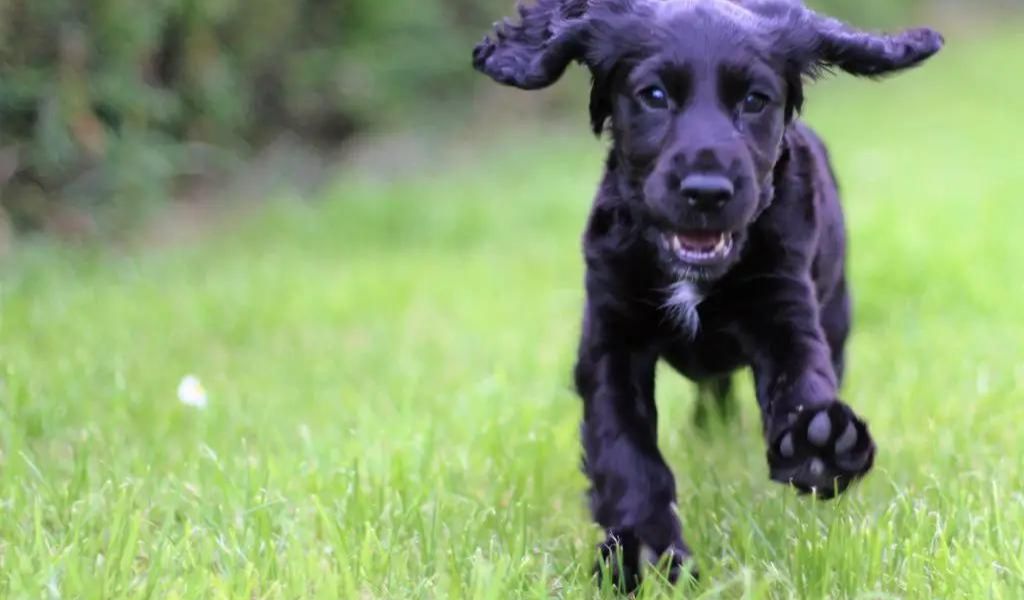
A simple daily Working Cocker puppy training routine
You don’t necessarily need dedicated training sessions for everything.
Training can fit naturally into your day.
For example:
Breakfast: practise sit or hup before putting the bowl down.
Morning: practise name recognition and one or two recalls in the garden.
During the day: gentle handling, settling and appropriate socialisation.
Afternoon: a couple of short retrieves indoors or in the garden.
Evening: another short recall or whistle exercise followed by calm time.
That’s plenty for a young puppy.
As your Cocker matures you can gradually make exercises more demanding.
Common Working Cocker puppy training mistakes
Doing too much too soon
Enthusiasm is good, but there’s no prize for producing the most highly trained 12-week-old puppy.
Give him time to mature.
Making sessions too long
Stop while your puppy is succeeding and still enjoying himself.
Repeating commands
If you repeatedly shout “come, come, come” while your puppy ignores you, you’re teaching him that the first command doesn’t matter.
Increasing distractions too quickly
A puppy that performs perfectly in your kitchen hasn’t necessarily learned the same behaviour in a field full of scent.
Increase difficulty gradually.
Getting angry when the puppy is confused
If your puppy doesn’t understand an exercise, make it easier.
Frustration rarely improves dog training.
Allowing too much uncontrolled hunting too early
A young Working Cocker can quickly discover that following scent and hunting independently is tremendous fun.
Give your puppy opportunities to explore, but don’t repeatedly put him into situations where you’re unable to influence him.
Turning every retrieve into a battle
Don’t chase your puppy or immediately snatch things from his mouth.
Make coming back to you the enjoyable part of retrieving.
Trying to tire a Cocker out constantly
Exercise is important, but so are sleep, calmness and learning to settle.
When should proper gundog training begin?
There’s an important difference between training a future gundog and putting a young puppy through formal gundog exercises.
From the moment a Working Cocker arrives home, you can build the behaviours that will eventually make advanced training easier:
- recall;
- sitting;
- retrieving;
- confidence;
- responsiveness;
- whistle association;
- staying connected to the handler.
More structured training can develop as the dog matures.
The Royal Kennel Club’s guidance places basic gundog training at approximately six to eight months, after the earlier puppy play and training stage.
But don’t become obsessed with the calendar.
Dogs mature at different rates.
There is little benefit in rushing a puppy into advanced training when the foundations aren’t secure.
What I’ve learned from training my own Cocker Spaniels
I’ve owned and trained spaniels for many years, and perhaps the most useful lesson I can give a new owner is this:
Don’t be in a hurry to produce a trained dog.
Enjoy producing one.
Working Cockers are full of character. They can be energetic, mischievous, sensitive, affectionate and occasionally frustrating—all within the same five minutes.
That’s part of their appeal.
I’ve had Cockers carry shoes around the house, charge enthusiastically into cover and investigate things that I would much rather they hadn’t.
I’ve also experienced the enormous satisfaction that comes when a young spaniel begins to understand what you’re asking and the two of you start working together.
You don’t achieve that by dominating the dog.
You achieve it through patience, consistency and understanding.
Frequently asked questions about Working Cocker puppy training
Are Working Cocker Spaniels easy to train?
Working Cockers are intelligent and capable of learning quickly, but their energy, hunting instinct and enthusiasm can make them challenging for an inexperienced owner.
The key is giving that intelligence and drive somewhere useful to go.
Short, consistent training sessions usually work better than long repetitive ones.
What should I teach my Working Cocker puppy first?
Concentrate first on name recognition, recall, sitting, toilet training and becoming comfortable on a lead.
For a future working dog, simple retrieving games and positive whistle associations can also begin while the puppy is young.
When should I start whistle training my Cocker Spaniel?
You can introduce a puppy to the sound and meaning of a whistle early by associating it with behaviours he already understands, particularly recall.
Keep it simple and positive.
More demanding whistle work can develop as the dog matures and his basic training becomes reliable.
How do I calm down a Working Cocker Spaniel puppy?
Don’t assume every burst of excitement means your puppy needs more exercise.
Working Cocker puppies also need plenty of sleep and should learn how to settle.
Use a predictable routine, provide appropriate mental and physical activity and deliberately include quiet periods during the day.
How much exercise does a Working Cocker puppy need?
The amount will depend on your puppy’s age, health and individual development.
A young puppy doesn’t need long forced walks to become a good working dog.
Exploration, appropriate play, training and plenty of rest are all important.
If you’re unsure about the appropriate physical exercise for a growing puppy, ask your vet.
Why does my Working Cocker ignore me outside?
Usually because the outside world is far more distracting than your training environment.
Scent, birds, other dogs, people and movement can all compete for your puppy’s attention.
Go back a stage and practise in an easier environment before gradually adding distractions.
Should I let my Working Cocker puppy hunt?
Exploring and using his nose are natural behaviours and shouldn’t be discouraged completely.
However, I wouldn’t allow a young puppy to spend every outing hunting independently and learning that disappearing into cover is more rewarding than staying connected to me.
Balance freedom with recall, interaction and simple training.
Final thoughts
Training a Working Cocker Spaniel puppy isn’t about seeing how quickly you can progress through a list of commands.
You’re building a relationship with a dog that will hopefully be with you for many years.
Start early.
Keep your training simple.
Be consistent.
Reward the behaviour you want.
Don’t rush when things aren’t going according to plan.
And remember that your puppy is still a puppy.
Build strong foundations now and you’ll be in a much better position when the time comes to progress to more advanced training.
Most importantly, enjoy it.
A Working Cocker is an enthusiastic, intelligent and entertaining training partner, and watching a young puppy gradually develop into a capable adult dog is one of the most rewarding parts of owning a spaniel.